
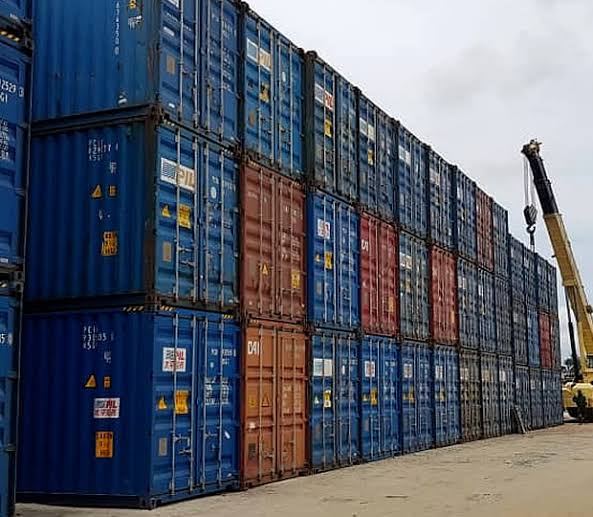
LAGOS At 8 a.m. on a Wednesday, the gates of ITC Bonded Terminal should be busy. Trucks should be queuing. Forklifts should be lifting. Workers should be clocking in.
Instead, the gates are locked. The yard is empty. The staff who once earned a living here are now at home, jobless.
ITC is not alone.
Across Lagos, more than 10 licensed indigenous bonded terminals have folded in the last few years. Another 30 are hanging by a thread, operating at less than 5% capacity. The reason, according to the Association of Bonded Terminals Operators of Nigeria (ABTON), is simple: nobody is sending them cargo.
“We are rich in infrastructure, but poor in patronage,” says ABTON Secretary-General, Haruna Omolajomo. “In Lagos alone, we have over 40 indigenous bonded terminals. We have spent more than N5 trillion to equip them with modern infrastructure and machinery. I can tell you authoritatively that none is operating beyond 10 percent.”
The Billion-Naira Ghost Yards.
Bonded terminals are the lungs of Nigeria’s port system. Licensed by Customs, they store, examine, and clear imported goods away from congested seaports. They defer taxes, speed up cargo flow, and create thousands of jobs. Some of them clame they were used and dumped by the government.
But today, many of these facilities are “ghost yards” — built with borrowed money, now sitting idle.
Cresadasa Bonded Terminals, once a major player, is gone. So is Alliance Bonded Terminals. Mid Mar, Port & Cargo, Duncan Bonded Terminal, and Sapid Bonded Terminal are all operating below 5% capacity. Between them, they employed 400 staff. All are now laid off.
“For those that are lucky, they are battling high blood pressure,” Omolajomo says. “For those that are not lucky, they are already six feet below the ground.”
The Foreign Takeover
The collapse is not accidental. It is, ABTON argues, by design.
Foreign shipping companies and seaport concessionaires have built their own off-dock terminals in Lagos. Instead of sending cargo to indigenous bonded terminals, they “stem” it directly to their sister companies.
“What I mean is that the foreign concessionaires are foreigners. Even the shipping companies bringing cargoes to our ports are mostly owned by foreigners,” Omolajomo explains. “Many of these shipping companies and seaport concessionaires have established off-dock terminals. They send their own stevedores to the ports. They have completely cut off the indigenous bonded terminal operators.”
The result? Indigenous terminals, which invested billions in cranes, warehouses, and customs-compliant systems, are starved of business.
“In saner climes, the local content law protects indigenous firms, but that does not apply in Nigeria,” he adds. “In Ghana, the local content law provides that the ports must give indigenous firms some of the cargoes that come to the ports.”
The Debt Trap
The pain is not just economic, it’s personal.
Terminal owners borrowed from commercial banks to build facilities. Now, with no cargo, they can’t repay. Some have taken on “high blood pressure” as stress mounts. Others have lost everything.
“They are struggling to repay bank loans. For some that are lucky, they are battling high blood pressure. For those that are not lucky, they are already six feet below the ground,” Omolajomo says.
He points to a cruel irony: “Many of the workers of these bonded terminals are just sitting down without any attendance because there are no jobs to be done. Even to get empty containers, they are not getting. Many of the bonded terminals are just there, doing nothing.”
A Call for Policy
ABTON has not been silent. The association has taken its case to the Presidency, the National Assembly, and other bodies. The National Assembly even set up a panel of inquiry.
“But since that time till this very day, it all amounted to nothing,” Omolajomo admits.
His solution is straightforward: a government policy that mandates 30% of port cargoes go to indigenous bonded terminals.
“When indigenous bonded terminals get cargoes from the port operators, it will increase the revenue of the port operators and Federal Government. This is aside creating jobs for more Nigerians,” he says.
The Human Cost
Behind the numbers are families. The 800 workers at the closed terminals are