
The Chief Consultant Global Transport Policy, Dr. Oluwasegun Musa has stated it again and again that the recently launched National Single Window will only work if the necessary preparations and capacity building programmes are carried out as well as the needed enlightenments done before the project will achieve the proposed gains.
Dr. Musa who is also the Chief Executive Officer, CEO of Widescope International Group quite agreed that the national single window is one project that could change Nigeria’s old narratives and repositions the nation and its economy favourably, if well implemented.
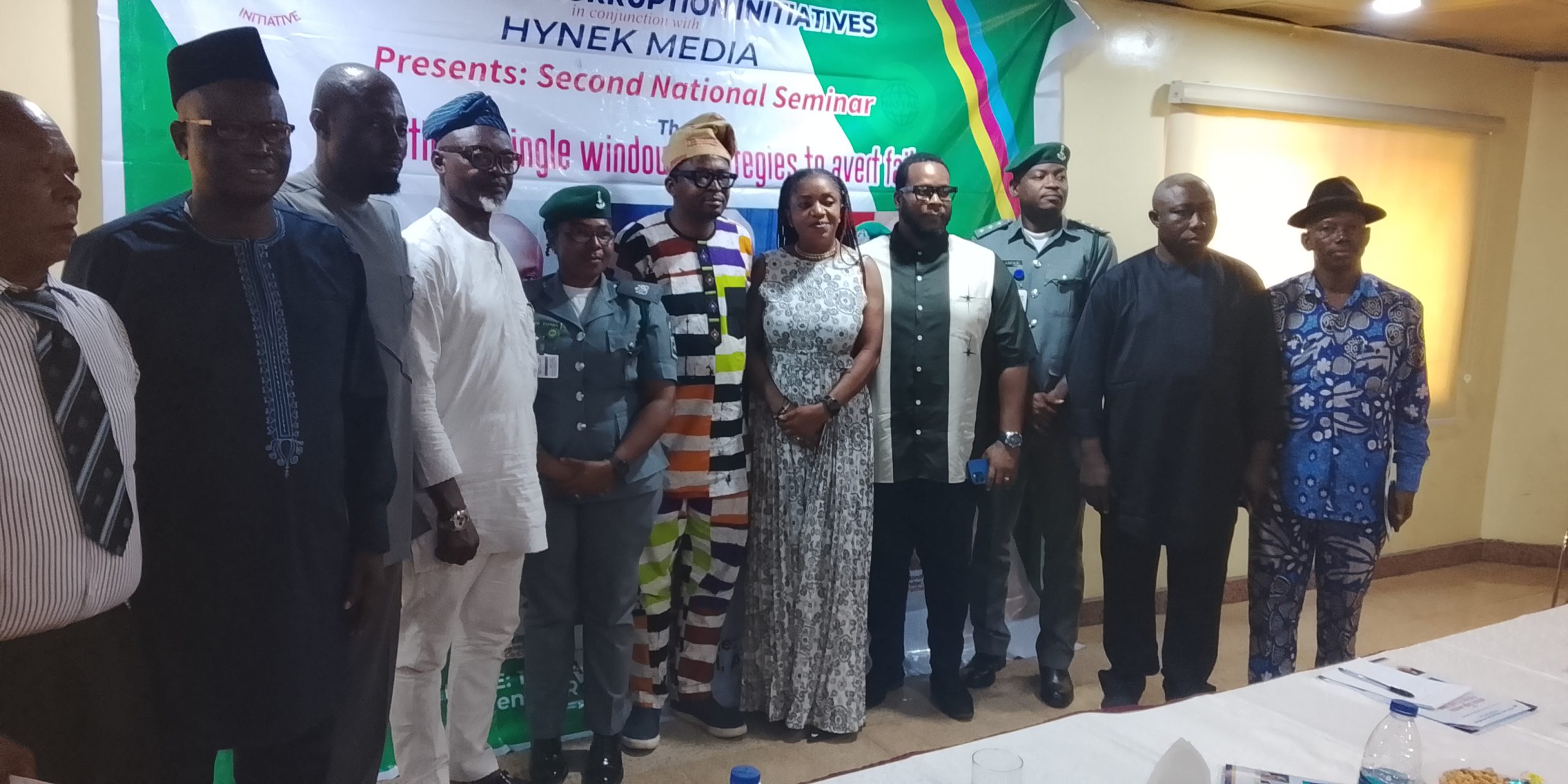
Speaking at the second National Seminar of the Media Anti-Corruption Initiative organized in conjunction with Hynek Media, the distinguished technocrat and transport expert, who was represented by Mr. Onoruoiza Mark Onuchi, emphatically insisted that more works are needed to be done to really get the scheme functional by educate the general public and also train those who needed to be trained.
Dr. Musa, who was the Guest Speaker at the event tagged: “National Single Window: Stratagies To Avert Failure,” however told the stakeholders that, the launch of the scheme for trade was a watershred moment but it’s success depends on rigorous preparation and execution.
To the guest speaker, (Dr. Musa), Nigeria was about to launch something big: the National Single Window for trade. But Musa wasn’t there to celebrate yet. He was there to warn.
He warned:
“This is a watershed moment,” he began. “But its success depends on rigorous preparation and execution. Without that, our Single Window will be dead on arrival.”
He let that sit. Around the world, the stakes were clear. A World Bank analysis showed countries with efficient trade systems record about 15% higher exports and 10% more foreign investment. The upside was billions. The downside was familiar. UNCTAD had already written the obituary for most trade reforms: about 70% falter when training and capacity are inadequate.
What Singapore Asked That We Must Ask
He pointed to countries that got it right. Singapore. South Korea. Sweden. The United States. Closer to home, Kenya and Mauritius. Their secret wasn’t software. It was political will, full buy-in from every agency, and relentless training.
“Kenya tied its Single Window to the President’s ‘Big 4 Agenda,’” Musa said. “It wasn’t an IT project. It was national strategy.”
Then came the story that made the room shift. “Singapore didn’t scan 35 paper forms into a computer. They asked a simple question: _Why do we need 35?_” The answer became one e-Form. One.
“If Nigeria must succeed, we need that kind of holistic reform,” he said. “Not an upgrade. A redesign.”
Seven Things That Decide Success or Failure
Dr. Musa laid out the fundamentals like checkpoints. Miss one, and the whole system stalls.
First, train the people._ Customs officers, port managers, the men and women who touch cargo daily. UNCTAD’s 2022 report was blunt: inadequate training is why most implementations die. Hands-on workshops, not PowerPoints.
Second, fix the rules._ The NSW must stitch together customs, ports, health, environment, and industry. Integrated policy reforms can lift trade throughput by 20–30%. But if one agency’s rule contradicts another’s, the new software just moves delays from paper to screen.
Third, build what you can touch._ Africa’s broken roads and logistics already cost about 2% of GDP every year. Nigeria bleeds growth at choked ports, dark checkpoints, and powerless offices. “We need broadband at every border post. 24/7 power at processing centers. Warehouses that can actually hold goods,” Musa said. “Software without infrastructure is theatre.”
Fourth, connect everything._ The World Trade Organization found that end-to-end digitalization of customs can cut transaction times by 20–30%. The NSW can’t stop at data entry. It has to talk to banks, shipping lines, and regulators so cargo is released in minutes, not days.
Fifth, plan for the fight._ Disputes will come — cargo holds, tariff classifications, agency clashes. The International Chamber of Commerce says clear dispute mechanisms cut trade disruptions by roughly 40%. “Build the fast-track appeal process now,” Musa urged. “A few unresolved cases can paralyze the entire window.”
Sixth, punish cheating and reward honesty._ OECD studies show effective enforcement can raise overall compliance by about 50%. That means real-time risk engines, audit trails, fines for false declarations, and anti-corruption measures that bite. “If misuse is detected and penalized quickly, people comply voluntarily,” he said.
Seventh, use the data._ A good NSW will pour out information: shipment times, tariffs, patterns. That data finds revenue leaks, guides where to build roads, and flags smuggling. “Data is not just economics,” Musa noted. “It’s national security.”
Looking at it from this angle, one form one portal one Culture, he finally described the vision as a true one-stop shop. Importers submit documents once — customs, licenses, health certificates — and the system does the rest. No redundant paperwork. No human bottlenecks. And the private sector has to co-design it. “If exporters and freight forwarders don’t shape this, it won’t meet business needs,” he said.
The Payoff If We Get It Right
Musa closed with the promise and the price. Modernized trade facilitation means 15% higher exports and 10% more FDI, according to the World Bank. That translates to jobs, investment, and prosperity.
“Launching Nigeria’s National Single Window, he added, is not a technical upgrade,” he said, looking across the room. “It is a strategic overhaul of our trade ecosystem. The time to act is now. Train. Integrate. Build. Digitize. Enforce. Do that, and we won’t just launch a Single Window. We’ll launch it for success.”